

Understanding Equestrian Equipment Rules & Regulations
Whether training or competing, understanding the rules and regulations affecting equestrian equipment is essential. Governing bodies regulate equipment to ensure fairness at a competitive level, but also in the interests of rider safety and horse welfare. As research into these areas continues to develop and products improve, rules and regulations can be subject to change. Riders are responsible for making sure that both their own equipment and their horse’s tack meet current regulations — even at unaffiliated competitions, where organisers often follow affiliated guidance.
In this guide, we aim to draw together key information on hats, body protectors, whips, spurs horse boots and other regulated equipment, to provide the clear and practical guidance that you need to ride with confidence.*
*We recommend that you contact the relevant governing body for your chosen discipline if you are ever unsure about any rules and regulations regarding equipment.
Riding Hats
The British Horse Society (BHS) and other bodies strongly recommend that all riders wear a correctly fitted, approved safety hat when mounted – whether you are at an event or riding at your leisure on private land.
- A compliant riding helmet is mandatory whenever you are mounted at affiliated competitions, including warm‑up areas.
- Hats must meet recognised safety standards and, in some disciplines, be tagged by an approved official before competition.
To ensure that your hat remains safe, usable and in good condition, avoid storing it in places like tack rooms where it could be subject to extreme temperature changes.
Riding Hat Standards
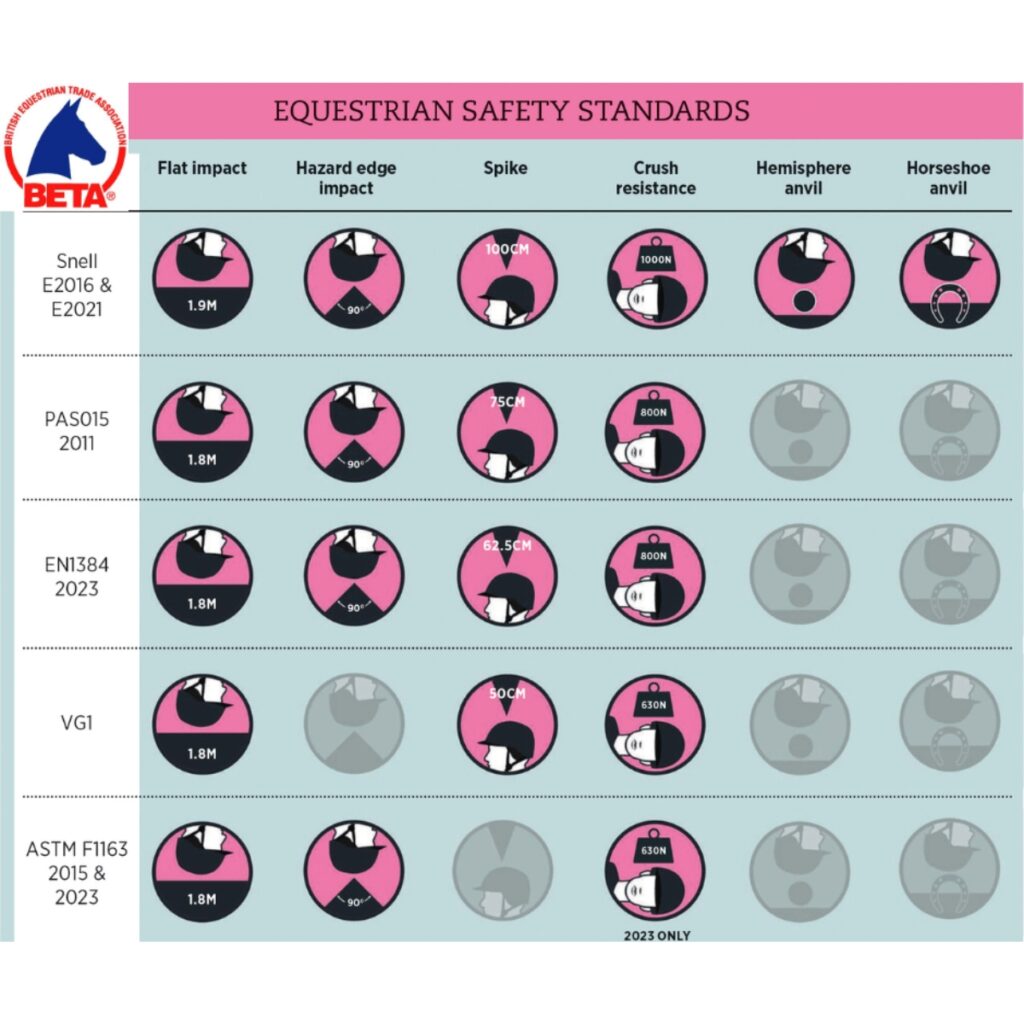
Riding hat standards are a reflection of the safety tests that a hat has been put through to demonstrate the protection it offers a rider in the event of a fall or a strike to the head.
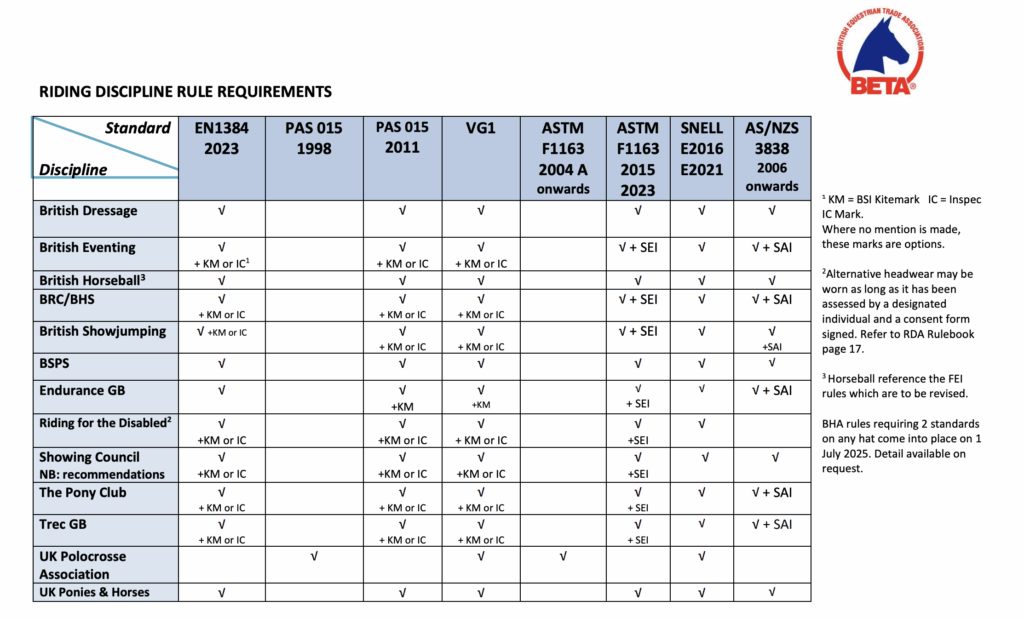
Commonly accepted standards across British Eventing, British Dressage, British Riding Clubs, Pony Club, BUCS Equestrian and other organisations include:
- PAS 015:2011 (with BSI Kitemark or Inspec IC mark)
- VG1 01.040:2014‑12 (with BSI Kitemark or Inspec IC mark)
- EN 1384:2023 (with BSI Kitemark or Inspec IC mark)
- ASTM F1163 (2015 or newer, with SEI mark)
- SNELL E2016 / E2021
- AS/NZS 3838:2006+
The BETA guide below gives a useful overview of the different testing requirements for each standard, and an indication of the protection that different riding helmets offer.
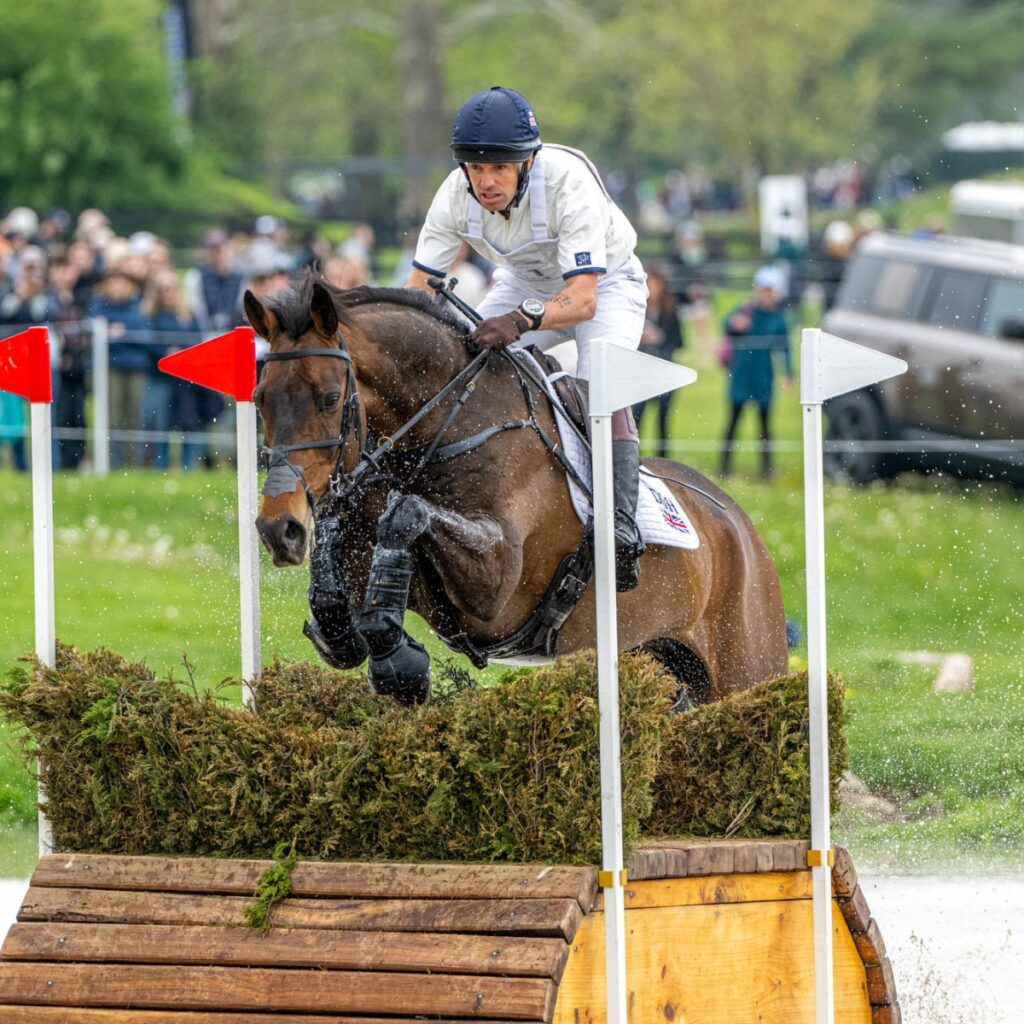
For cross-country riding, hats must be of a skull cap design without a fixed peak.
See the BETA Riding Discipline Rule Requirements table below for information about the different hat safety standards required for different disciplines.
Riding helmets should be replaced every 3-5 years, or after an impact (this could be a fall or if the riding hat has been dropped).
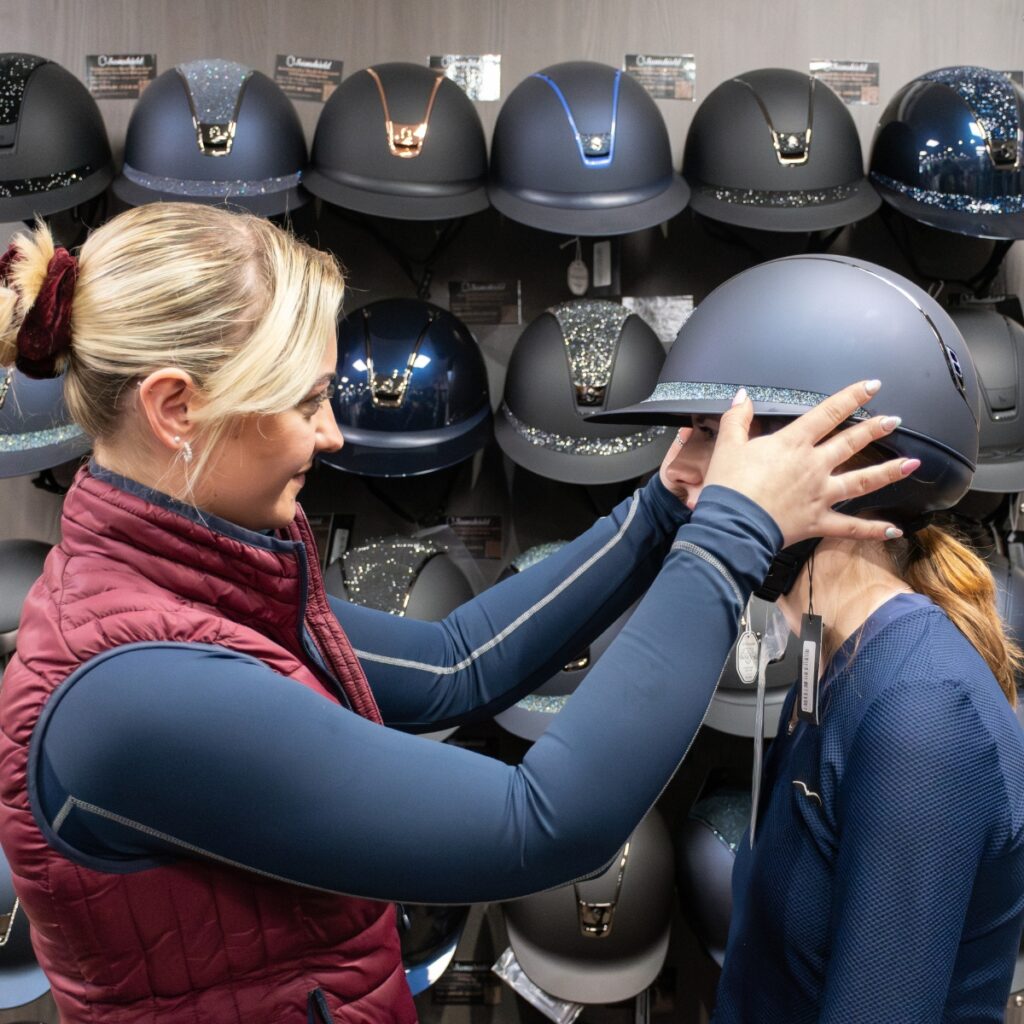
A correctly fitting hat is crucial for your safety and comfort. At Redpost Equestrian, we have a team of qualified specialists who can offer a fitting service (either virtual or in store) and professional advice to ensure that you can purchase your riding helmet with complete confidence.
Body Protectors & Air Jackets
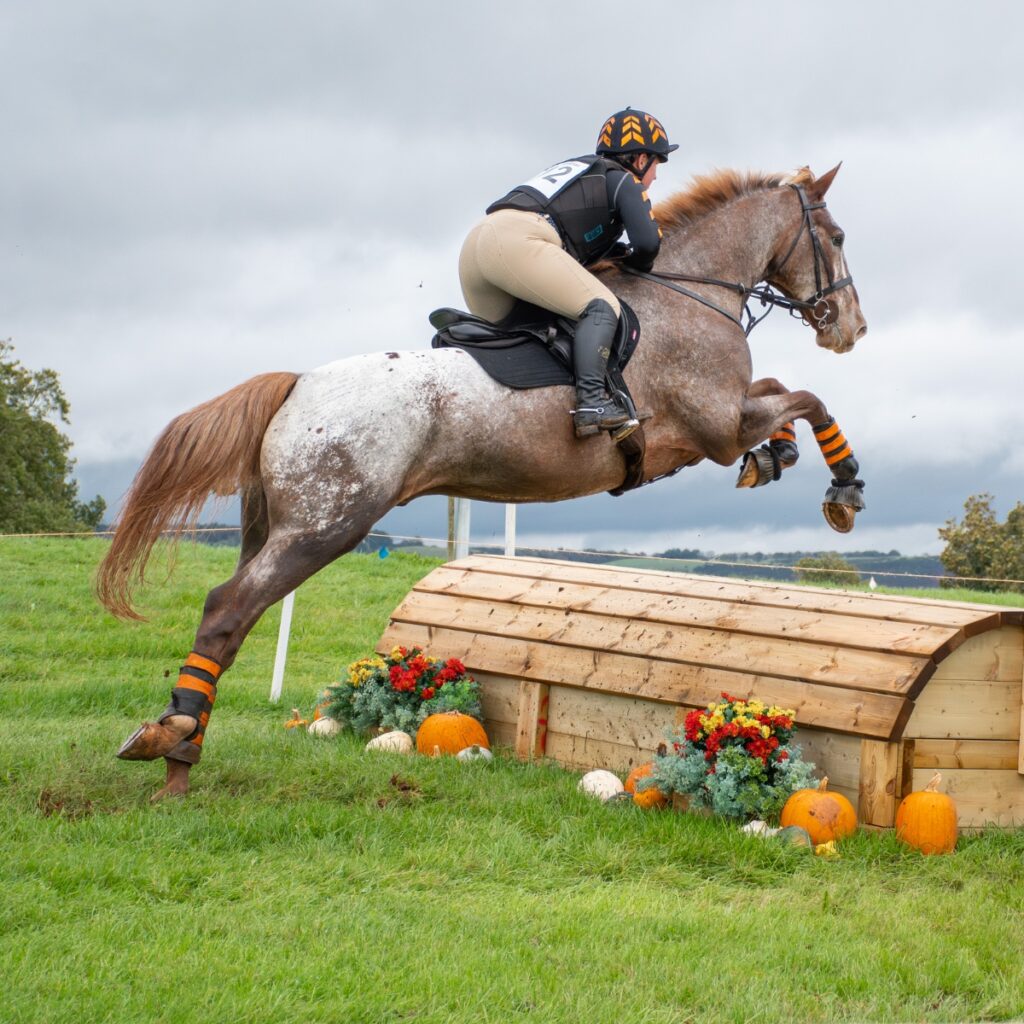
Body protectors are designed to reduce the severity of injuries in the event of a fall. For disciplines like eventing and hunter trials, they are compulsory.
At Redpost Equestrian, we stock a range of body protectors, air jackets, and back protectors designed for riders of all ages and disciplines.
- You will find options from top-rated brands that meet current UK safety standards, including BETA Level 3 – ideal for competition, cross-country, or everyday training.
- Many products are adjustable for a personalised fit, with breathable fabrics and flexible construction to keep you comfortable while staying protected.
To ensure that your body protector/ air jacket remains safe, usable and in good condition, avoid storing it in places like tack rooms where it could be subject to extreme temperature changes.
Body Protector Standards
The current widely accepted standard is BETA 2018 Level 3 (blue and black label). Older standards, such as BETA 2009, are no longer accepted at many affiliated competitions. Level 3 is considered appropriate for general riding, competitions including eventing and working with horses.
To be safe and effective, body protectors must:
- Fit correctly when mounted
- Cover the ribcage and vital organs
- Not restrict the rider’s movement
Air Jackets
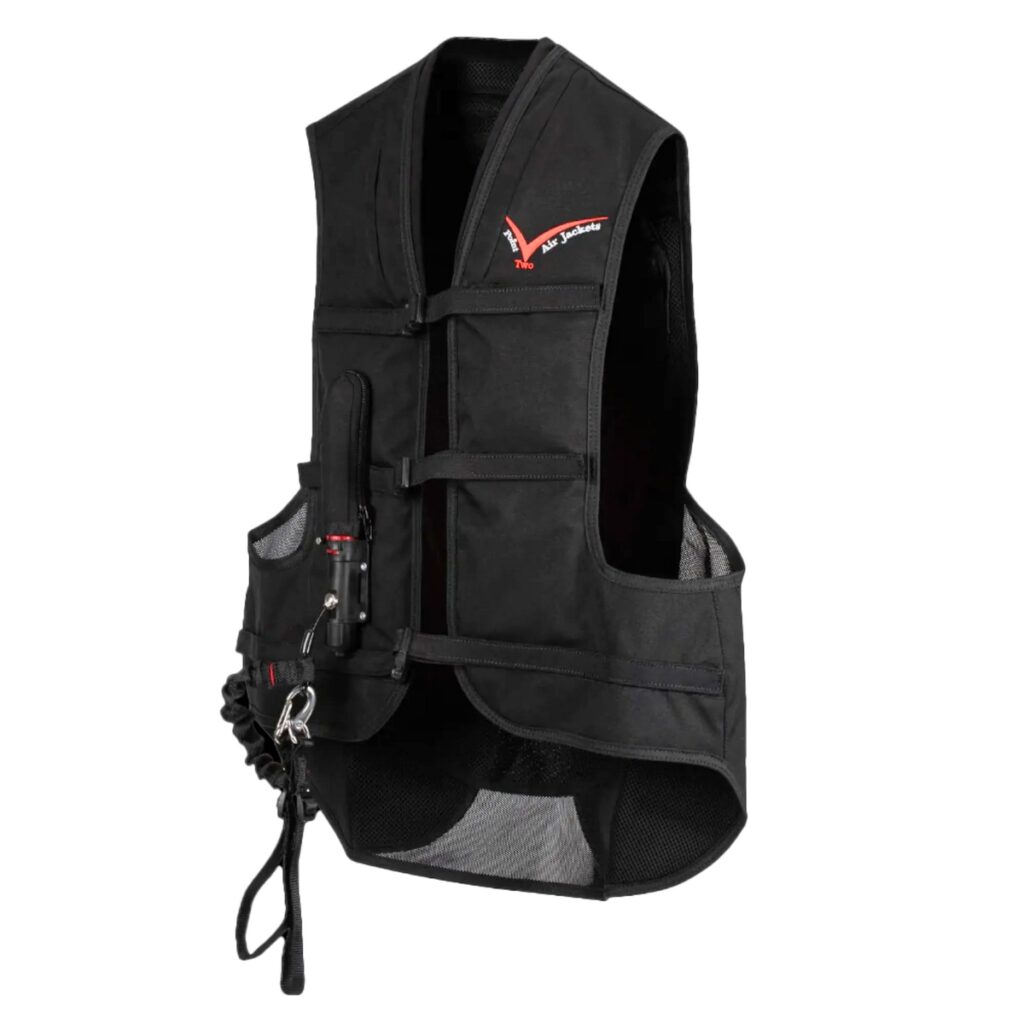
Air jackets are permitted by many governing bodies and can be worn with or without a body protector underneath for dressage and showjumping. For cross country riding, air jackets must be worn over a compliant body protector, not instead of one.
Rules vary by discipline and level and can regularly change or be updated, so riders should always check current guidelines before competing.
- British Eventing and The Pony Club: Air jackets must be worn over a permitted BETA Level 3 (2018 standard) body protector, or as an integrated hybrid jacket for Cross Country. Air jackets are permitted without a body protector underneath for Dressage and Showjumping.
- British Riding Clubs: Similar to above – in mandatory back protector phases, air jackets need to be worn over a Level 3 Body Protector, but can be worn alone where a body protector is not required (like showjumping or dressage).
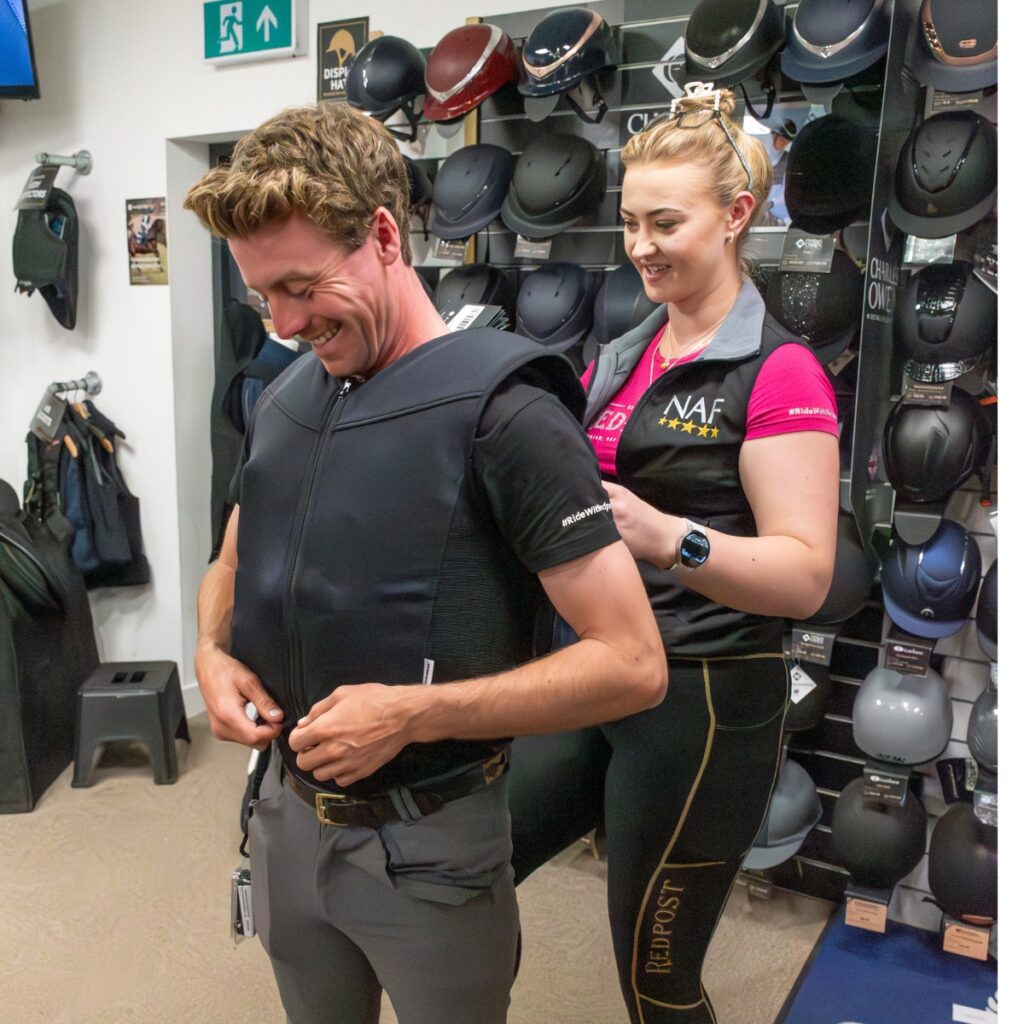
Our friendly team of specialists can offer a free fitting service. These can be done virtually or in store.
Whips and Batons
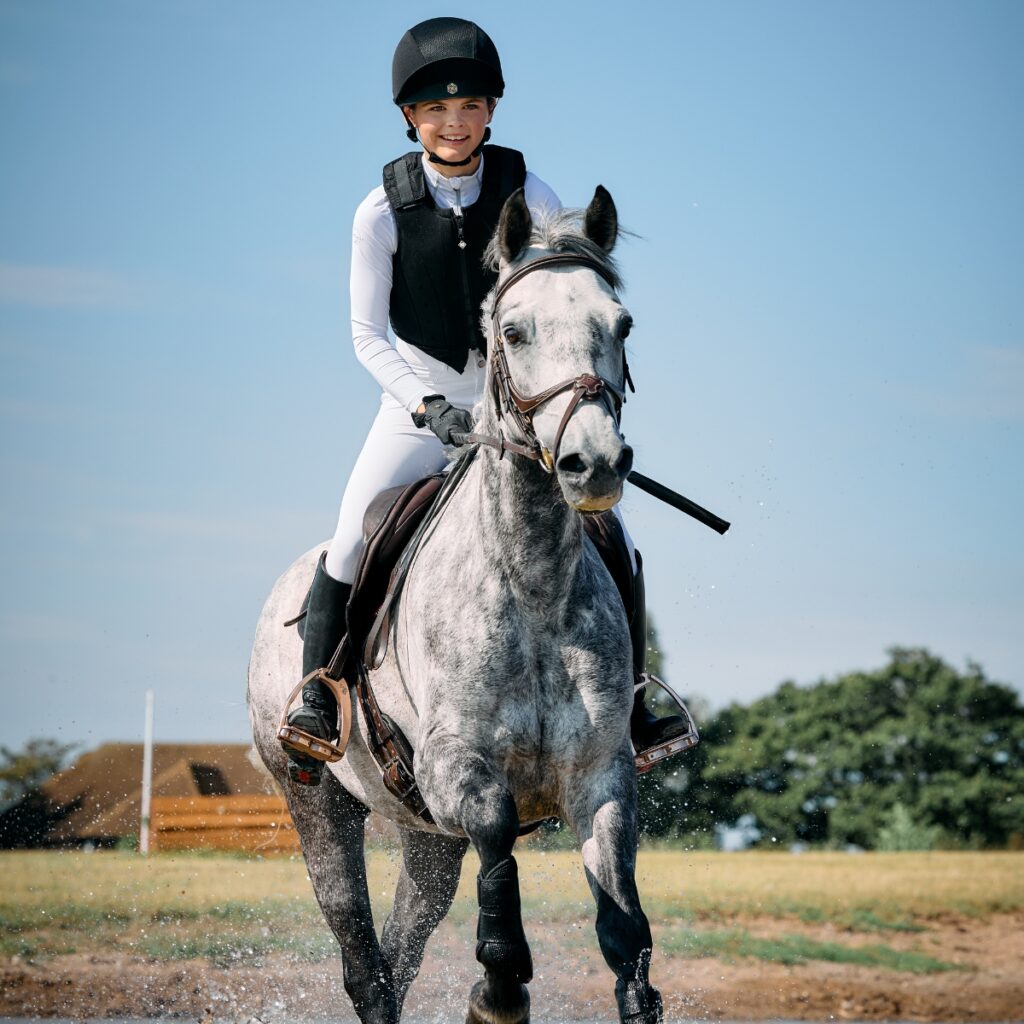
Whips and batons are regulated by governing bodies to horse welfare reasons and to ensure fair riding practices. Rules vary between disciplines, but in competitions restrictions are often in place regarding the length and style of the whip and the manner in which it is used. Always consult the rule book of the relevant governing body and contact the organiser of the particular show/ competition if you are unsure.
Discipline Examples
British Dressage:
- Carrying more than one whip without special dispensation is not permitted
- Whips may be used at Premier Leagues unless the selectors specify otherwise, but may not be used at Area Festivals, Associated Championships, Middle Tour Championships, Combined Training Championships, Regionals or Winter/National Championships. Failure to adhere to this rule will result in elimination from the class.
- Excessive or inappropriate use of the whip is also prohibited.
British Eventing:
- In the Dressage phase, no whip is permitted in any BE test
- In the showjumping and cross-country phases, one whip of 45–75cm is permitted
- The whip must have a padded end. The padded end must be smooth and made of shock absorbing material. There is to be no wording, advertising or personalisation on the pad
- The minimum diameter of the shaft of the whip is 1cm and that shaft should run through the entirety of the whip
- The whip should not exceed 160g and should be weighted evenly
- Excessive use of the whip is prohibited.
British Showjumping:
- One whip of 45-70cm is permitted
- The whip must have a padded end. The padded end must be smooth and made of shock absorbing material. There is to be no wording, advertising or personalisation on the pad
- The minimum diameter of the shaft of the whip is 1cm and that shaft should run through the entirety of the whip
- The whip should not exceed 160g and should be weighted evenly
- Excessive use of the whip is prohibited.
Endurance GB:
- Whips are prohibited in Competitive Endurance Rides (CERS)
- Whips are currently permitted in graded Endurance rides but are subject to rules
- They should not exceed 75cm in length, should only be used behind the leg, should not be used excessively, on a tired horse, or on the head or neck.
Spurs
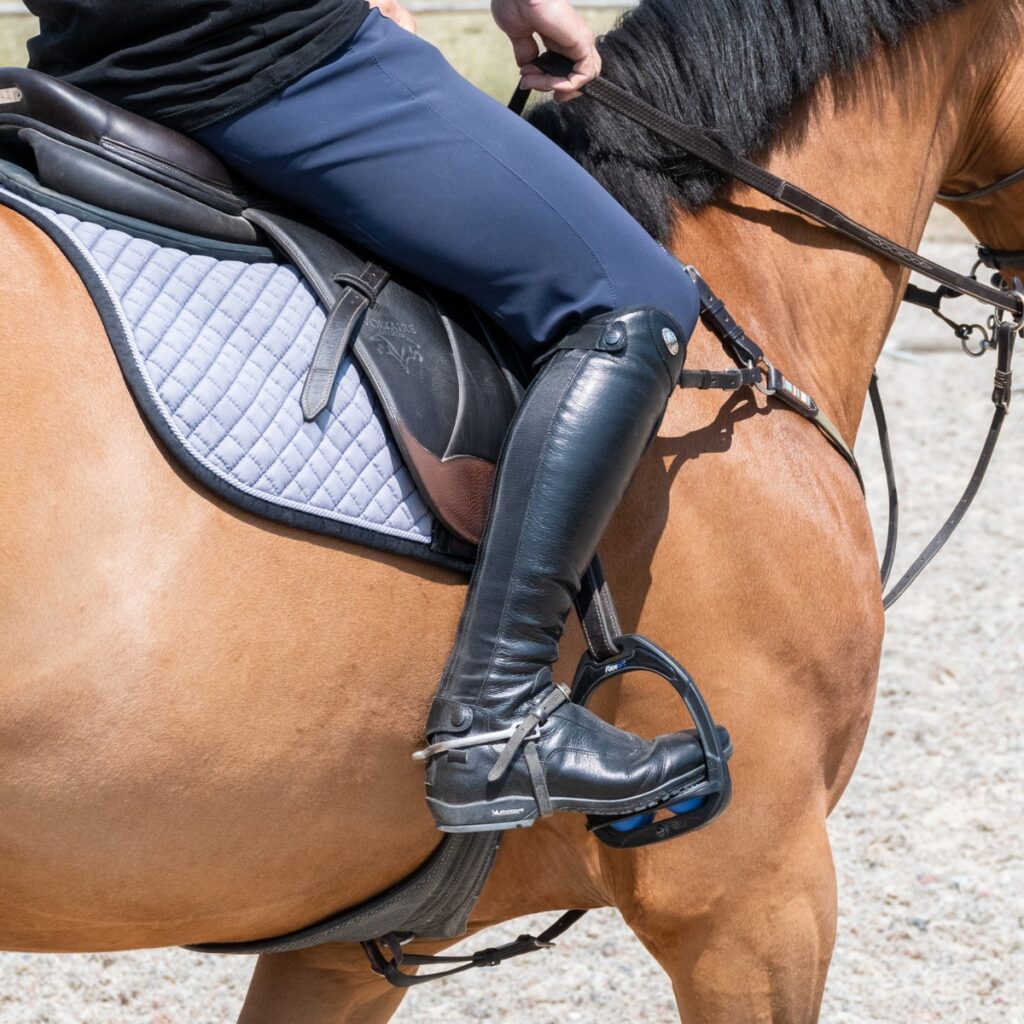
Spurs are designed to refine a rider’s leg aids, and should never be used aggressively or to increase force. Spurs are permitted in some competitive disciplines, but their use is closely regulated to protect horse welfare and ensure fair, sympathetic riding.
Discipline Examples:
British Dressage:
- Spurs may now be worn at all levels
- The shank of the spur must be horizontal to the ground or pointing down
- Spurs must be made of metal (which may be coated) and used in their manufactured state
- Failure to adhere to the rules can result in elimination.
British Eventing:
- Spurs are optional at all levels
- Spurs must be of smooth material (metal or plastic), blunt and incapable of wounding a horse
- ‘Dummy spurs’ with no shank are allowed but if there is a shank it must not be more than 4cm long, must point only towards the rear and, if curved, the shank must point downwards. The overall shank must be measured from the boot to the end of the spur
- Rowel spurs are permitted but not at all in Young Horse Classes. Rowels must be free to rotate and must be round and smooth
- Spurs with interchangeable / removable shanks are not permitted.
British Showjumping:
- Spurs of excessively severe design are not to be worn
- Spurs must be of smooth material (metal or plastic)
- The end of the shank must be blunt and must point only towards the rear
- Only one pair of spurs are to be worn, secured to the rider’s foot in the traditionally correct manner, with the curve of the neck of the spur directed downwards
- The overall length of the spur is not to exceed 4cm, measured from the back of the boot to the end of the spur, in its entirety
- Only Dummy, Rollerball, Impulse, Rowelled & Prince of Wales Spurs* are allowed to be worn. Rowelled spurs if worn, must have smooth rowels, with a diameter of no less than 1cm and no greater than 2cm, with a minimum width of 1.8mm. The rowels must sit in the vertical plane, horizontal rowels are not allowed (*As of April 2026, hammerhead spurs are no longer permitted. Flex-on spurs and Sprenger Fair rider spurs are also now not permitted).
- Spurs with interchangeable/removable shanks, spurs with necks set on the inside of the heel, spurs with roughened or cutting edges, serrated spurs, with or without necks are not allowed
- In pony competitions, in precedence to the above, the overall length is not to exceed 2.5cm measured from the back of the riders boot. Rowelled spurs are forbidden in these competitions
- The misuse of spurs is an offence.
Pony Club:
Members wishing to ride with spurs at Pony Club activities must:
- Have achieved the C+ Riding Test or the Spurs Achievement Badge, and should have still hands and a seat that is sufficiently independent that they can maintain a quiet, stable, still leg position.
- Spurs should comply with the maximum dimensions defined in the rulebook for the sport in which the member is participating
- They should be fitted correctly, with the shank pointing slightly downwards
- They should only be used as an additional aid, to back up and refine the leg aids -never be used to punish the horse
- A rider misusing spurs will be required to remove their spurs and should only resume wearing spurs when they have demonstrated to an accredited Pony Club coach that they can meet the minimum expected requirements consistently.
Horse Boots & Bandages
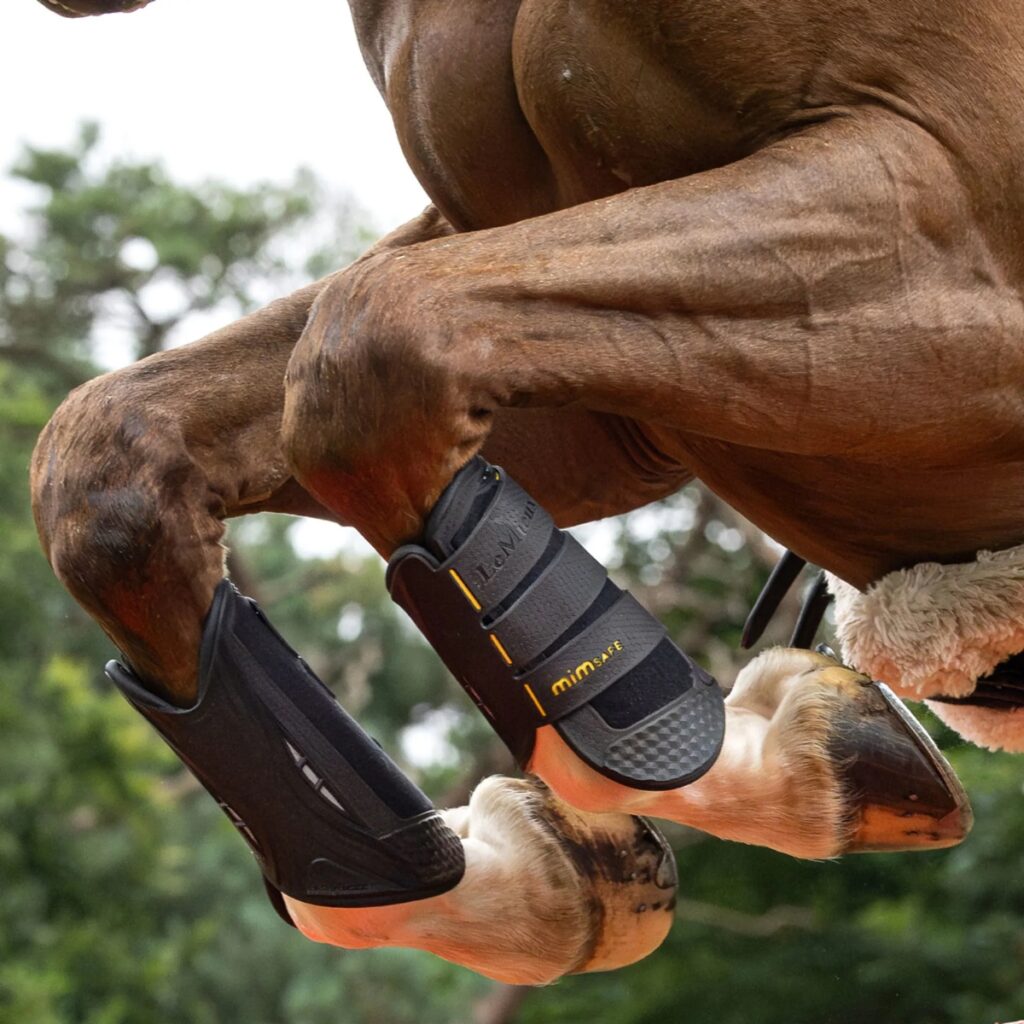
Boots and bandages are used to protect the horse’s legs, but their use is not unrestricted.
Discipline Examples:
British Dressage:
Boots and bandages are not allowed during tests but may be worn in warm‑up.
British Showjumping:
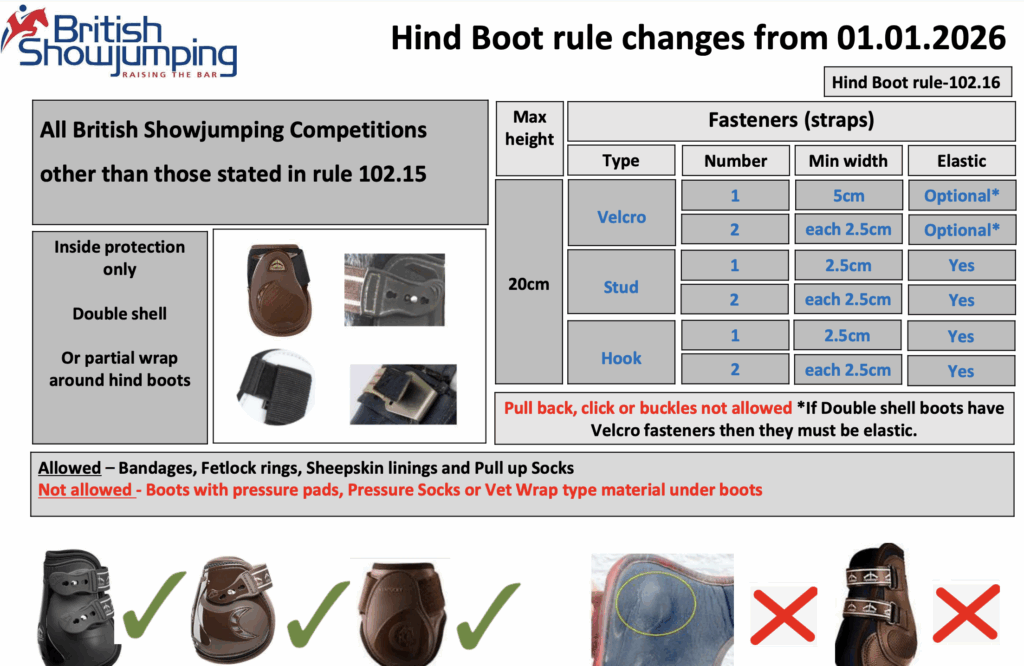
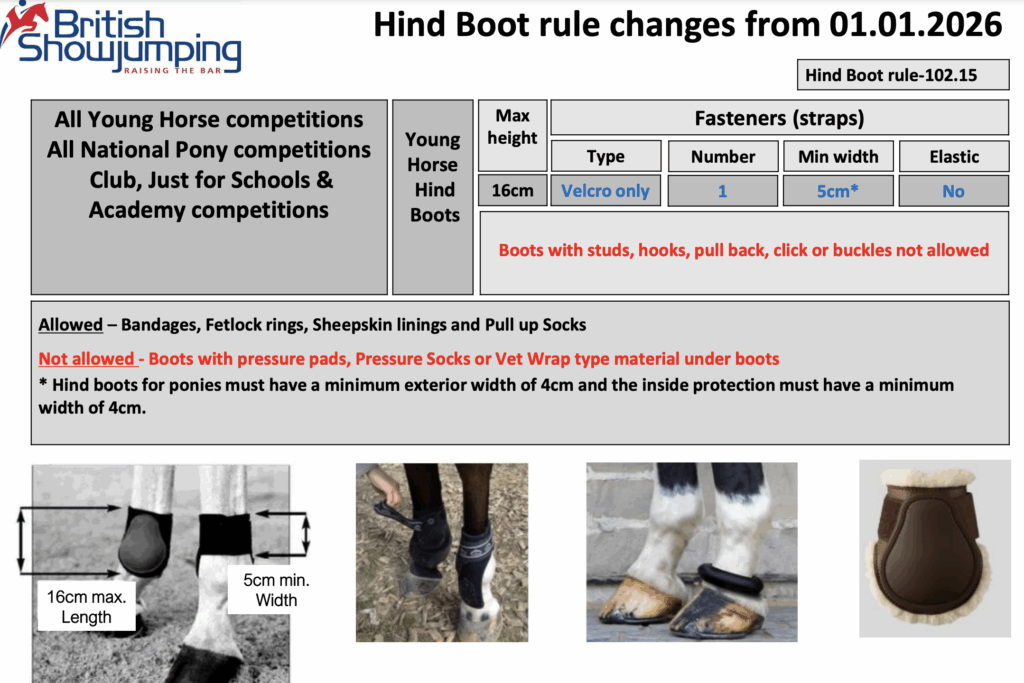
The following FEI ruling applies to a wide range of classes and competitions, but always check the rulebook for the particular class you are entered for:
- The total maximum weight of equipment allowed to be added to a horse’s leg is 500 grams
- All hind leg protections must have a maximum interior length of 16cm and a minimum exterior width of 5cm (4cm for pony classes)
- The inside protection must be smooth and the fixings must be made of non-elastic Velcro type fasteners with no hooks or straps permitted and must have a minimum width of 5cm (4cm for pony classes)
- The rounded rigid part of the protection must be placed around the inside of the fetlock
- No additional elements may be used in conjunction with the protection
- Hind boots for classes under this rule that have an extra flap for protection should be allowed providing the flap is soft and clearly intended for protection only
- Fetlock rings may be used in addition for protective purposes providing they are properly adjusted and providing the total weight of equipment on the horse’s leg does not exceed 500 grams.
British Eventing:
- All boots must be smooth inside without lumps, protrusions, or a rough surface
- For showjumping, boots may only have Velcro, Stud or Hook fasteners (straps)
- Single and Double shell boots are allowed
- Any boot that has a pull back, cinch, winch, buckle or click/ratchet fastener (straps) that double back is not permitted
- The Maximum height of hind boots allowed is 20cm. Pastern bands and Pastern Rings are allowed for all jumping phases.
Bits
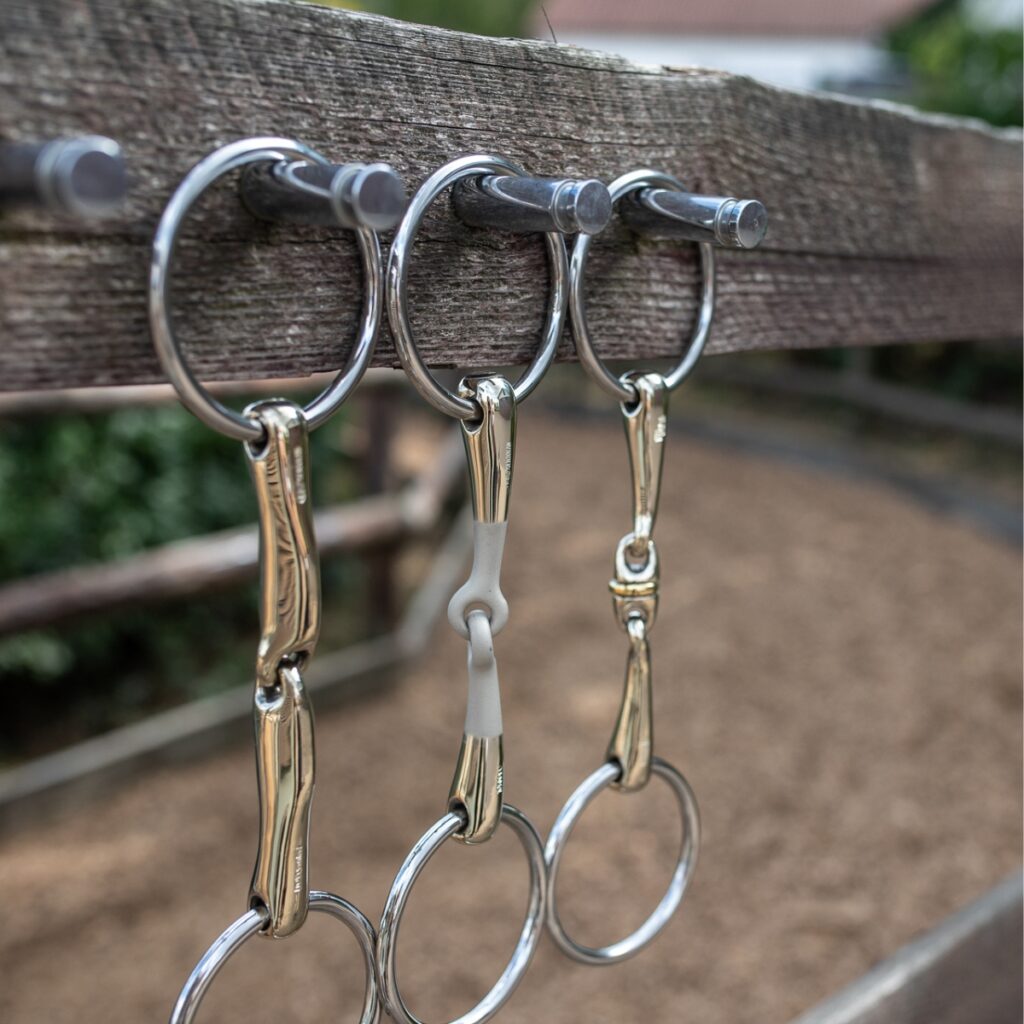
Bits are regulated to prevent discomfort and encourage correct training. Many governing bodies maintain approved bit lists and conduct tack inspections at events. Riders are advised to regularly review permitted tack lists, particularly when moving up levels or disciplines.
Discipline Examples:
British Dressage:
Any combination of permitted cheeks and permitted mouthpieces can be used under BD rules.
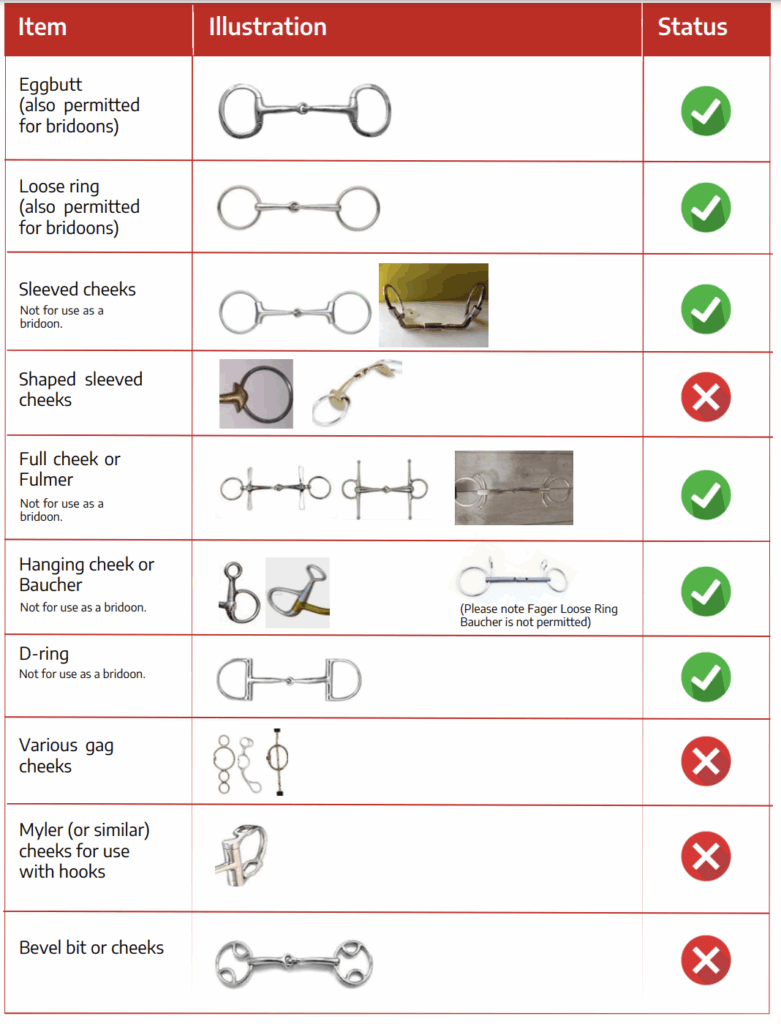
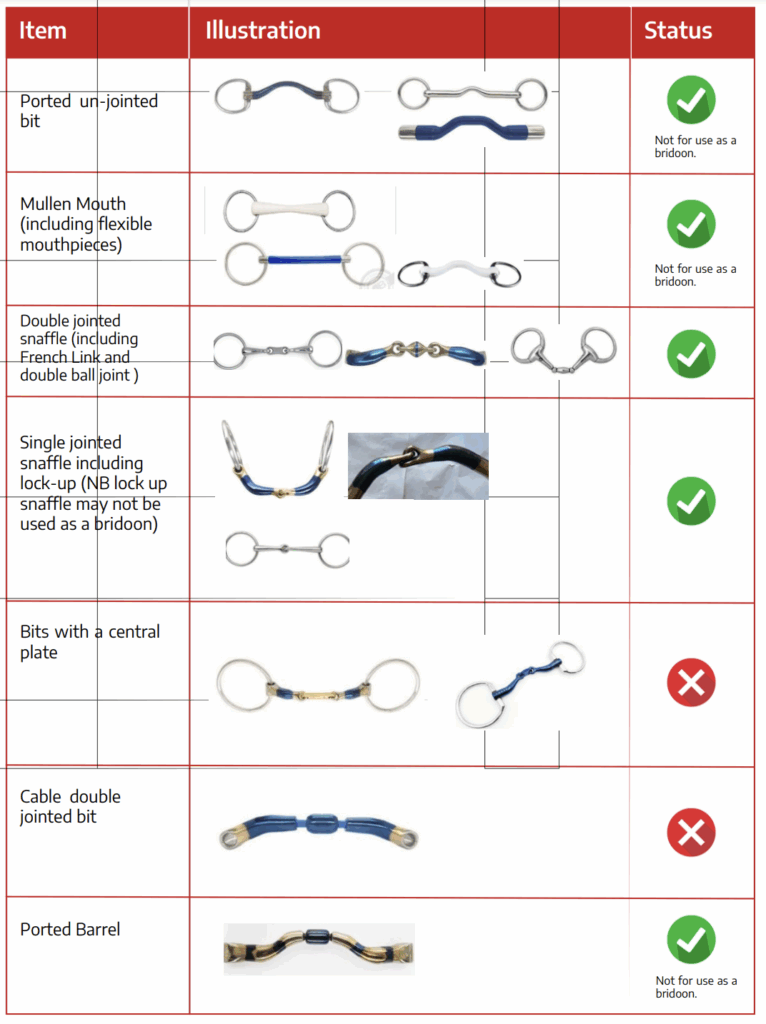
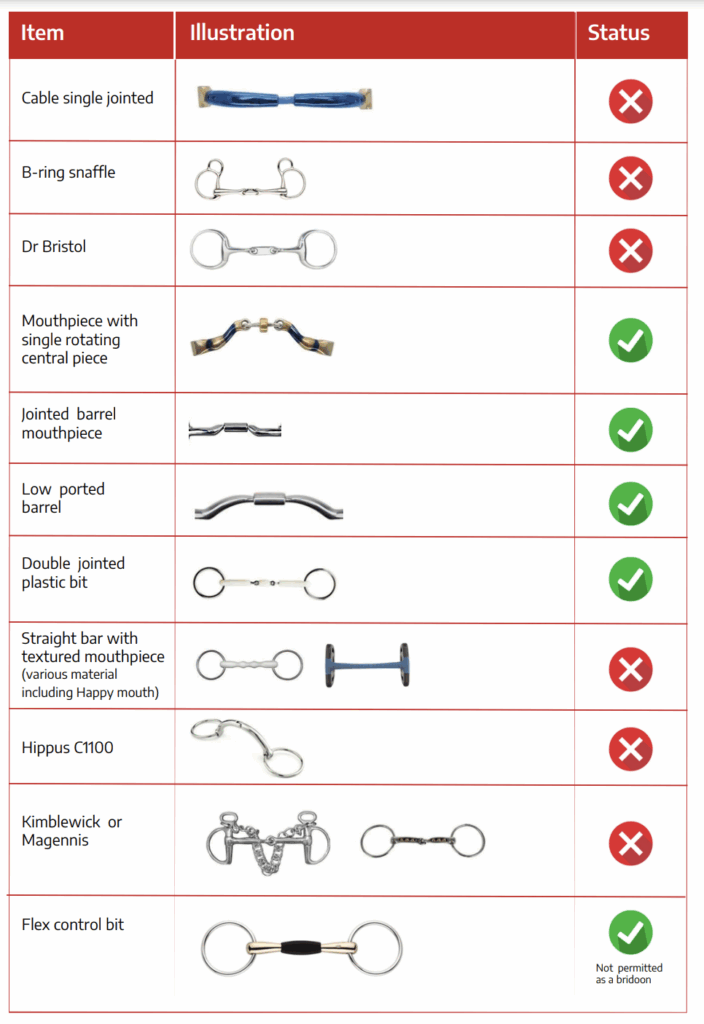
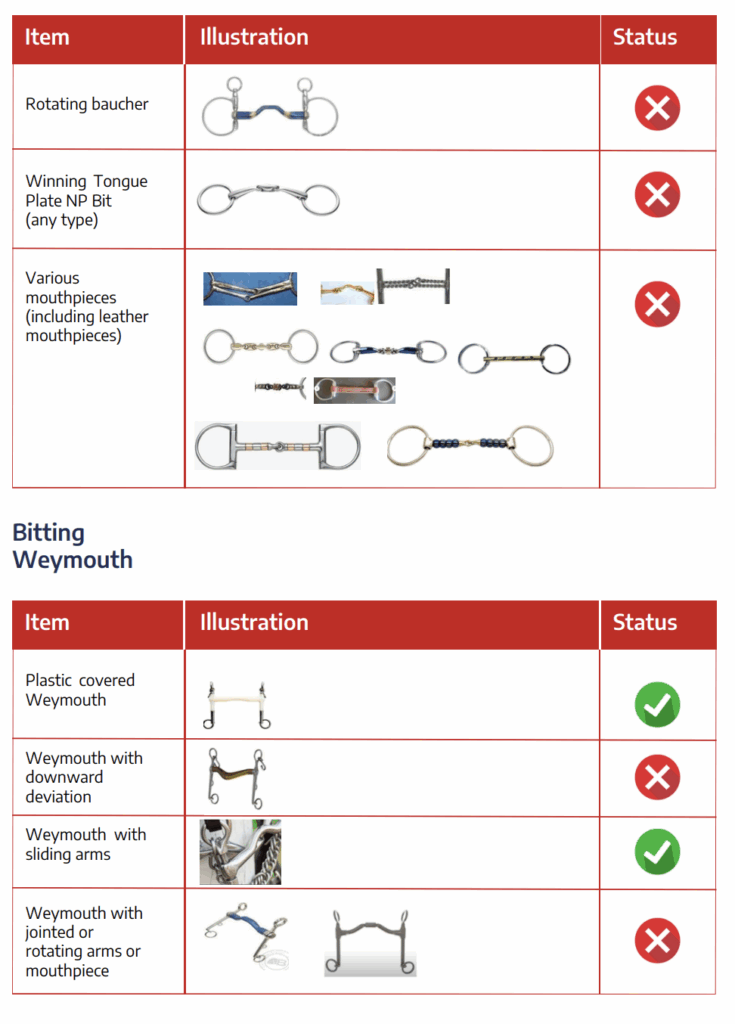
British Dressage also has clear rules about which bridles, saddles, stirrups and other items of tack/ equipment are permitted. Competitors are advised to study the rules carefully prior to a competition to ensure that they are fully compliant.
British Showjumping
**Please note, British Showjumping have recently made changes to their equipment rules, and some previously permitted items (including several bits) are now no longer allowed (with effect immediately or from 1st April 2026.)**
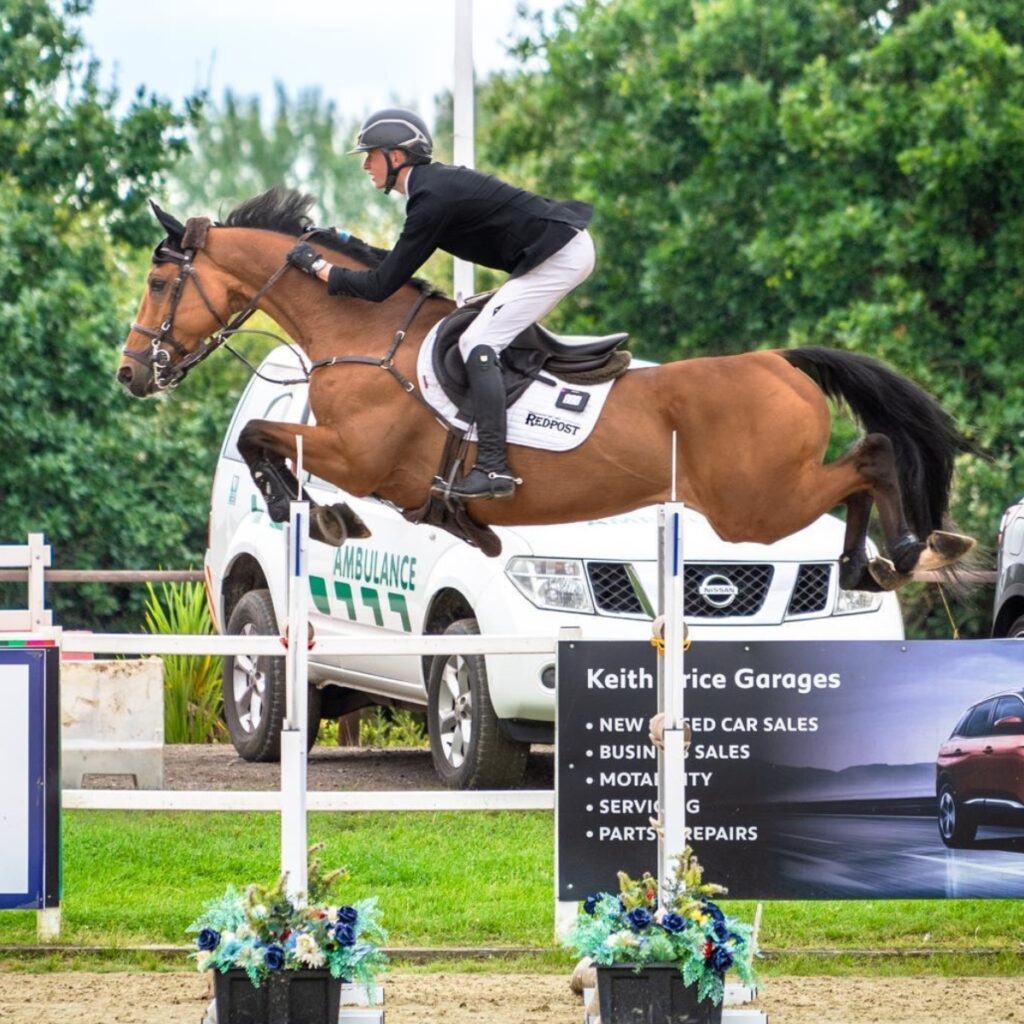
British Showjumping allows a wide variety of bits, including snaffles, gags, pelhams and hackamores.
Cheltenham gags are permitted (with two reins, not with roundings), as are two or three-ring gags. Pelham, Kimblewick, and Weymouth bits must have a properly fitted curb chain of an appropriate length.
Myler combination bits are not permitted. Other combination bits are permitted in Horse combinations.
Always check the most recent, up-to-date Equipment Clarification Document for any equipment changes. The March 2026 edition can be found here.
For specific, equipment related questions for BS classes and competitions, email: [email protected]
British Eventing
For British Eventing competitions, only bits which are described and illustrated in the British Dressage Tack Guide are permitted for the dressage phase.
For showjumping and cross country, competitors may use any normal jumping bit, Pelham, American or Continental gag, hackamore and any form of bitless bridle. Only Pelhams, Kimblewicks and Weymouth may use a correctly fitted curb chain. Metal chains are not permitted on any other type of bit.
Rider Clothing & Accessories
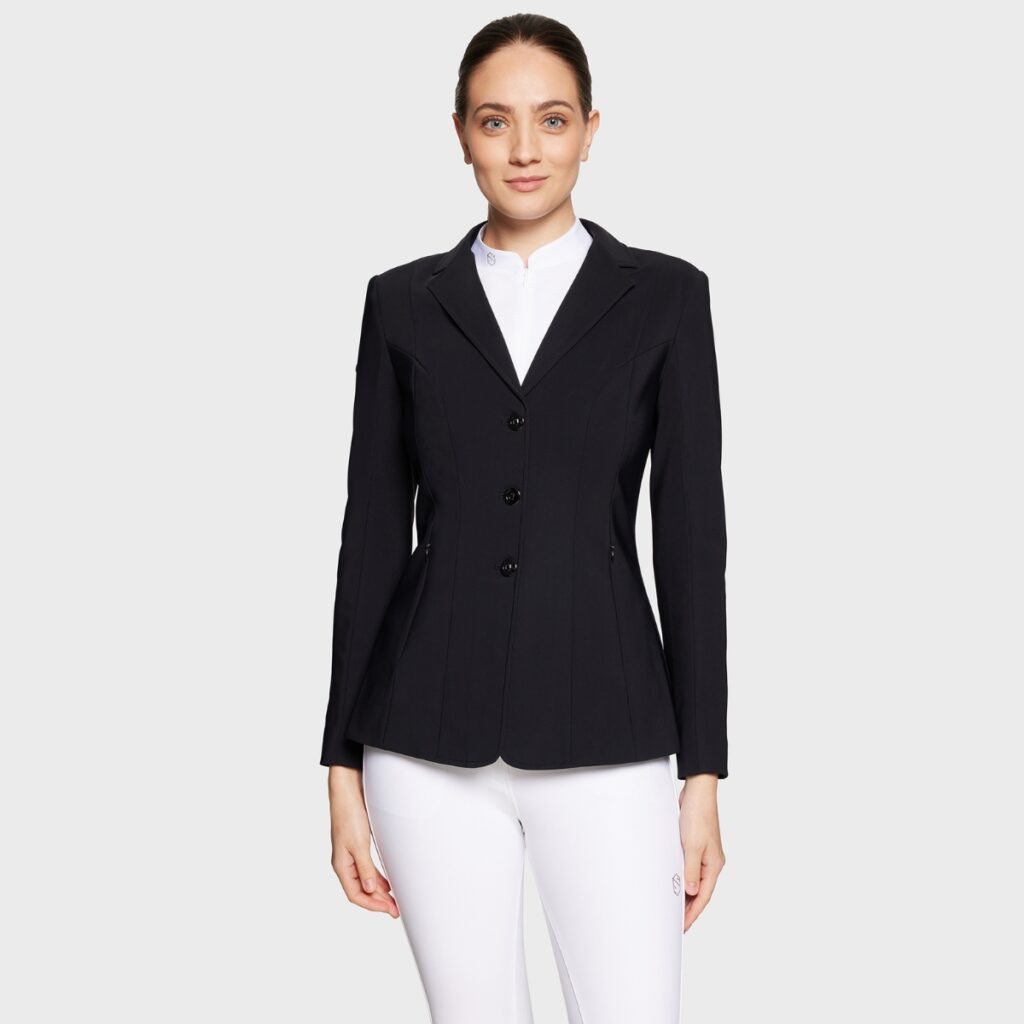
Governing bodies regulate rider clothing for both safety and presentation.
In particular, clothing rules may affect:
- Boot styles
- Breeches or jodhpurs (colour and material restrictions)
- Gloves (mandatory in some disciplines)
- Hair containment and jewellery rules
These regulations are particularly important in dressage and showing disciplines, where turnout can form part of the judging criteria.
Keeping Up to Date
At Redpost Equestrian, we recommend:
- Checking rulebooks at the start of each season
- Replacing safety equipment before it becomes non‑compliant
- Asking for advice if you are unsure about any item
Our knowledgeable team are always happy to help you choose suitable equipment in line with current regulations.
Useful Further Resources

- British Equestrian Trade Association (BETA)
- British Eventing
- British Dressage
- Pony Club
- British Riding Clubs and BUCS Equestrian
- British Showjumping
- British Endurance
- British Carriage Driving
- BSHA
- BSPS
- FEI: Tack, Equipment and Dress